O'Hare Connecting Flights: 5 Tips For Stress-Free Layovers
O'Hare connecting flights are one of the most common layover scenarios for travelers across the United States and beyond. Whether you're flying domestically or internationally, understanding how connections work at Chicago O'Hare International Airport (ORD) can save you time, stress, and missed flights. This guide breaks down everything you need to know about navigating O'Hare connecting flights, from minimum connection times to terminal changes, and what to do when things go wrong.
Key Takeaways
- O'Hare is a major hub for connecting flights, with multiple terminals and a complex layout that requires careful planning.
- The minimum connection time you need depends on your route (domestic vs. international) and whether you need to change terminals.
- The airport's automated transit system can help you move between terminals, but walking may be faster in some cases.
- If you miss a connection, your options vary depending on your airline, ticket type, and the reason for the delay.
- Booking a longer layover is often the best strategy, especially during peak travel times or winter weather.
The Complete Answer: How O'Hare Connecting Flights Work
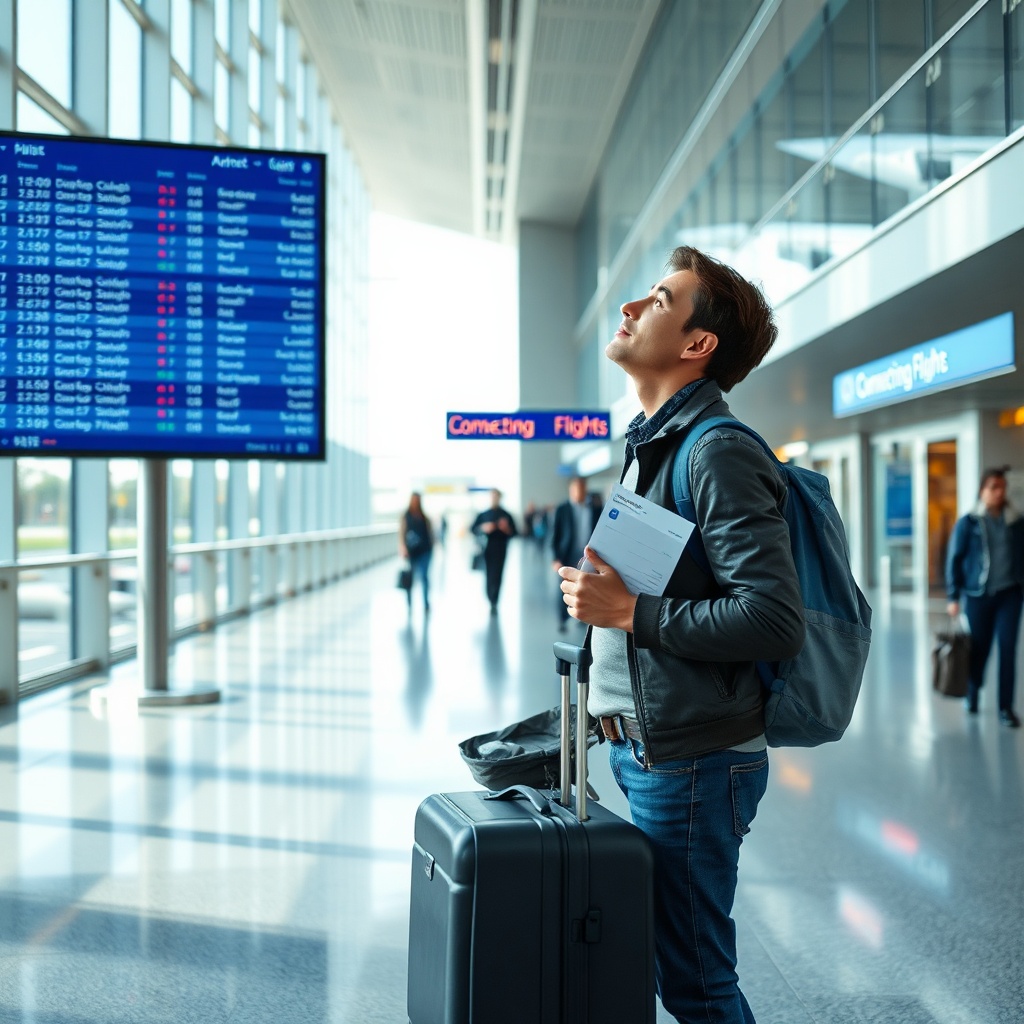
A passenger reviews departure details for O'Hare connecting flights in a bright terminal.
What Qualifies as a Connecting Flight at O'Hare
A connecting flight at O'Hare is any itinerary where you arrive at ORD on one flight and depart on another without leaving the airport. Connections can be domestic-to-domestic, domestic-to-international, international-to-domestic, or international-to-international. The key factor is that your bags are checked through to your final destination, and you do not need to clear customs unless you are arriving from an international destination and continuing to another domestic flight.
Quick Answer: A connecting flight at O'Hare is an itinerary where you arrive on one flight and depart on another without leaving the airport. Your bags are typically checked through, and you only need to clear customs if you arrive from abroad and continue on a domestic flight.

An elevated view of O'Hare airport's terminals and transit system, illustrating the layout for connecting flights.
The Core Process: Arrival, Transfer, Departure
Every connection at O'Hare follows the same basic sequence. You arrive at a gate in one terminal, follow signs to your next terminal or concourse, and reach your departure gate. The complexity comes from the fact that O'Hare has multiple terminals and concourses that are not all connected by a single walkway. You may need to use the airport's automated people mover or walk through underground tunnels.
Why O'Hare Is a Major Connection Hub
O'Hare is one of the busiest airports in the world and serves as a primary hub for several major airlines. This makes it a frequent connection point for flights between the East and West Coasts, as well as for international travel to and from Asia, Europe, and Latin America. Because of this, many travelers pass through O'Hare on connecting itineraries, and the airport is designed to handle high volumes of transfer passengers.
Minimum Connection Times at O'Hare
Domestic-to-Domestic Connections
For flights within the United States, the minimum connection time is typically shorter than for international connections. However, the exact time you need depends on your arrival and departure terminals. If you are connecting between two gates in the same concourse, you may only need a short buffer. If you have to change terminals, you need significantly more time. Always use the specific minimum connection times provided by your airline when booking, as they vary by airline and route.
Domestic-to-International and International-to-Domestic
Connections that involve an international flight require more time because you may need to clear customs and immigration. When arriving from an international destination and connecting to a domestic flight, you must go through U.S. Customs and Border Protection (CBP), collect your bags, recheck them, and then go through security again. This process can take a substantial amount of time. For domestic-to-international connections, you typically need to arrive at the international gate with enough time to board, but you do not need to clear customs.
Factors That Affect Your Connection Time
Several factors can increase the time you need to make a connection at O'Hare. These include the time of day (peak hours are busier), the terminal you arrive at and depart from, whether you have a gate check or a checked bag, and whether you are traveling with a wheelchair or stroller. Weather conditions and air traffic control delays can also add unexpected time. Always check the airport's real-time flight status and use your airline's app for guidance on the day of travel.
How to Navigate the Terminal Change at O'Hare
Step-by-Step: Changing Terminals at O'Hare
If your connection requires a terminal change, follow this step-by-step process to get to your next gate as efficiently as possible:
- Check your arrival and departure gates on your airline's app or on the airport screens as soon as you land.
- Determine whether you need to change terminals. If you are staying in the same terminal, follow the signs to your departure concourse.
- If you need to change terminals, look for signs directing you to the airport's automated people mover (the ATS) or to the pedestrian walkways.
- Board the ATS at the station located near your arrival gate. The ATS runs between all terminals and is free to use.
- Exit the ATS at the terminal for your departure flight and follow signs to your departure gate.
- Allow extra time if you need to go through security again, which is required for some terminal changes.
Using the Airport Transit System (ATS)
The ATS is the primary way to move between terminals at O'Hare. It operates continuously and is the fastest option for long distances. However, you should note that the ATS stops at each terminal, and you may need to walk a short distance from the station to your gate. If your connection is tight, the ATS is usually your best bet, but you should still plan for walking time at both ends.
Walking vs. Riding: Which Is Faster?
In some cases, walking between terminals can be faster than taking the ATS, especially if you are connecting between certain concourses. For example, some terminals are connected by underground pedestrian tunnels. Walking is also a good option if the ATS is crowded or if you have limited time and are already close to your departure terminal. The key is to know which terminals you are connecting between and to check the airport map before you decide.
What to Do If You Miss Your Connection at O'Hare
Your Rights and Options When You Miss a Connection
If you miss a connection at O'Hare, your options depend on your airline, your ticket type, and the reason for the delay. If the delay was caused by the airline, you are generally entitled to rebooking on the next available flight at no extra cost. If you missed the connection due to a late arrival from a previous flight, the airline is typically responsible for accommodating you. If you missed it because of a personal issue, such as arriving late to the airport, you may need to pay a change fee. Always ask the airline's customer service desk about your options, including meal vouchers and hotel accommodations if you are stranded overnight.
Quick Answer: If you miss a connection at O'Hare because of an airline delay, you are generally entitled to free rebooking on the next available flight. If you missed it for personal reasons, a change fee may apply. Always ask the airline about vouchers and accommodations.
Steps to Take Immediately After Missing a Flight
As soon as you realize you have missed your connection, go directly to your airline's transfer desk or gate agent. Do not wait in line for a new ticket at the main ticketing area, as the transfer desk is dedicated to connecting passengers. Have your boarding pass and passport or ID ready. Be polite but firm about your needs. Ask for the next available flight to your destination, and ask about any additional compensation you may be entitled to.
What to Do If You're Stranded Overnight
If no flights are available until the next day, the airline may provide a hotel voucher and meal vouchers. If they do not offer these automatically, ask for them. If you have travel insurance, check your policy to see if it covers missed connections. In some cases, you may be able to file a claim for expenses incurred due to the delay. Keep all receipts and documentation from the airline, including any written proof of the delay or cancellation.
O'Hare vs. Midway: Which Airport Is Better for Connecting Flights?
Comparison Table: O'Hare vs Midway for Connections
| Factor | O'Hare (ORD) | Midway (MDW) |
|---|---|---|
| Major international hub with many airlines | Smaller, focused on domestic and low-cost carriers | Connection volume |
| Very high; frequent delays possible during peak times | Lower volume; generally shorter security lines | Terminal layout |
| Multiple terminals and concourses; requires ATS or walking | Single terminal; easier to navigate | International flights |
| Extensive international routes | Limited international routes | Best for |
| Long-haul and international connections | Short domestic connections, especially with Southwest |
When to Choose O'Hare Over Midway
O'Hare is the better choice if you are flying internationally or connecting to a long-haul domestic flight. It has a much wider range of airlines and destinations, so you are more likely to find a nonstop connection to your final destination. O'Hare is also the better option if you are using one of the major legacy carriers that hub at ORD.
When to Choose Midway Over O'Hare
Midway is the better choice if you are connecting on a domestic flight, particularly if you are flying with Southwest Airlines. Midway is smaller and easier to navigate, and its single terminal means you are less likely to need a long transfer time. If you have a tight connection and are flying domestically, Midway may be less stressful than O'Hare.
Insider Tips and Tricks for O'Hare Connections
Timing Your Booking and Arrival
When booking a connecting itinerary through O'Hare, aim for a layover of at least 90 minutes for domestic connections and 2 to 3 hours for international connections. This gives you a buffer for delays and terminal changes. On the day of travel, check your flight status before you leave for the airport. If your inbound flight is delayed, your airline may automatically rebook you, but it is always best to be proactive and speak to a gate agent as soon as you land.
Security and Immigration Shortcuts
If you are connecting from an international flight, you may be able to use a dedicated CBP lane if you are rechecking bags. Some airlines offer expedited security screening for connecting passengers. Always have your boarding pass ready for the next flight, and keep your passport and ID easily accessible. If you have TSA PreCheck or Global Entry, you may be able to use those lanes at O'Hare, which can save time during security.
Lounge Access and Recharging During Connections
O'Hare has several lounges that you can access with a day pass, a credit card, or through your airline's frequent flyer status. Lounges offer comfortable seating, Wi-Fi, and sometimes showers, which can be invaluable during a long layover. Even if you do not have lounge access, there are plenty of charging stations and seating areas throughout the terminals. Look for areas near food courts and gates to recharge your devices and grab a bite to eat before your next flight.
FAQ: O'Hare Connecting Flights
What is the minimum connection time at O'Hare?
The minimum connection time at O'Hare varies by airline and route. For domestic connections, it can be as short as 30 to 45 minutes, but for international connections, it is typically longer. Always check your airline's specific minimum connection times when booking.
Do I need to go through security again for a connecting flight at O'Hare?
It depends on whether you are changing terminals. If you stay in the same terminal, you usually do not need to go through security again. If you change terminals, you may need to re-clear security, especially if you are connecting from an international flight.
Can I leave the airport during a long layover at O'Hare?
Yes, you can leave the airport if you have enough time. O'Hare is located about 17 miles from downtown Chicago, and you can take the Blue Line train or a taxi. However, you must factor in time for security again on your return, so only do this for longer layovers.
What happens if my bags are checked through to my final destination?
If your bags are checked through, you do not need to collect them during a domestic connection. However, if you are arriving from an international flight, you may need to collect your bags for customs and then recheck them for your next flight.
Is O'Hare a good airport for connecting flights?
O'Hare is a good airport for connecting flights because it offers a wide range of destinations and airlines. However, it can be busy and complex, so it is important to allow enough time for your connection and to know your terminals in advance.
Related reading: 7 Ways To Skip O'Hare Security Lines · How To Navigate O'Hare Terminals Easily · Ohare Vs Midway: Which Chicago Airport Should You Choos
Conclusion
O'Hare connecting flights are a routine part of air travel for millions of passengers, but they require a bit of planning to navigate smoothly. Understanding the airport's layout, knowing your minimum connection time, and having a plan for terminal changes can make all the difference. Whether you are flying across the country or around the world, taking the time to prepare for your O'Hare connection will help you arrive at your final destination relaxed and on time. Always use the resources available to you, such as your airline's app, airport maps, and real-time flight status, to make the most of your layover.