How To Beat O'Hare Weather Flight Delays In 2026
Introduction
When you're flying through Chicago O'Hare International Airport (ORD), weather is the single biggest cause of disruption. O'Hare weather flight delays in 2026 will look a lot like they did in previous years: thunderstorms in summer, snow and ice in winter, and fog or wind that quietly slows everything down. The key to beating them is understanding that the delay isn't caused by the weather itself — it's caused by the air traffic control constraints that weather creates.
This guide explains how those constraints work, how to track them in real time, and what to do when your flight is affected.
Key Takeaways
- O'Hare's weather delays are driven by air traffic control constraints, not just the weather itself.
- The most disruptive weather at ORD includes thunderstorms, snow/ice, fog, and high winds.
- You can track and predict delays in real time using FAA delay programs and airline tools.
- Hub effects mean a weather delay at O'Hare can ripple across your entire itinerary.
- In 2026, knowing your passenger rights and rebooking strategies is essential for navigating weather disruptions.
The Complete Answer: How O'Hare Weather Flight Delays in 2026 Happen
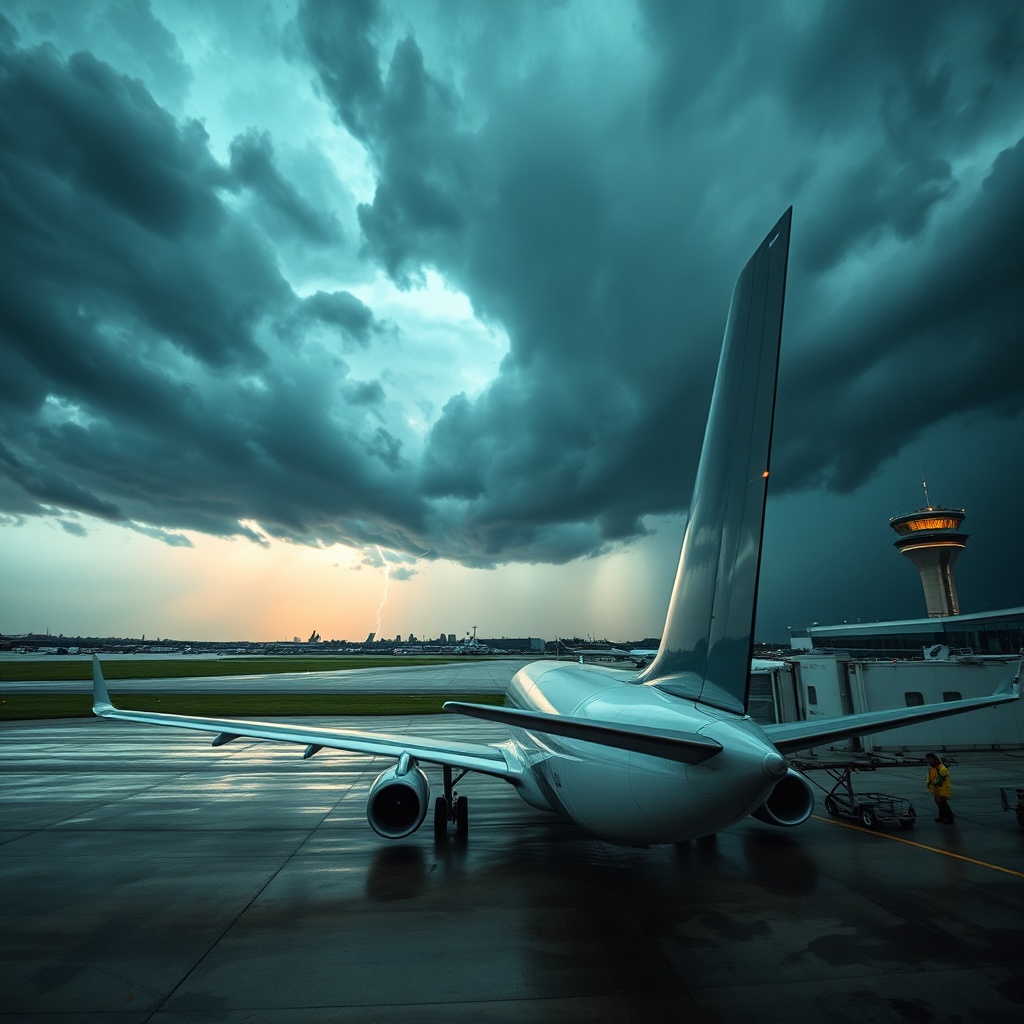
A dramatic view of a commercial jet at the gate as a summer storm approaches, highlighting the weather conditions that trigger ground stops.
The Core Mechanism: Weather → Air Traffic Control Constraints
O'Hare's weather delays are fundamentally air traffic control delays. When weather reduces the number of aircraft that can safely land or take off each hour, the FAA's Air Traffic Control System Command Center (ATCSCC) steps in to manage the flow.
The FAA issues a ground stop to hold all departures to O'Hare at their origin, or a ground delay program to assign each flight a new departure slot. Both are designed to space out arrivals and prevent the airspace from becoming overloaded.
Quick Answer: A weather delay at O'Hare is almost always an air traffic control delay. When storms, snow, fog, or wind reduce runway capacity, the FAA steps in with ground stops or ground delay programs to keep the airspace safe and orderly.
The key distinction is between weather at O'Hare and weather elsewhere. A thunderstorm over the Ohio Valley or a snowstorm in Denver can also delay flights to O'Hare, because the FAA manages the entire national airspace as one system. If there's a ground stop at ORD, flights already airborne are held in the air; flights on the ground at other airports are delayed before departure.

A frosty scene of a passenger jet undergoing de-icing, illustrating the winter weather that can disrupt flight schedules.
The 2026 Context: What's Changed
The fundamental mechanics of O'Hare weather flight delays in 2026 remain the same as in prior years. The airport still operates under the same runway and airspace constraints, and the FAA still uses the same flow-control tools.
What has changed is your access to real-time information. Airlines and third-party tracking apps now push delay alerts and rebooking options directly to your phone, which means you can often act before the gate agent announces anything. Long-term infrastructure programs at O'Hare aim to add capacity, but weather-related constraints are driven by conditions in the airspace, not by terminal buildings alone.
Quick Reference: Delay Causes and Typical Impacts
The table below summarizes the general patterns. Specific delay times vary by storm intensity, time of day, and air traffic volume.
| Weather Type | Typical Delay Impact | Primary Mitigation |
|---|---|---|
| Widespread ground stops and holds | FAA flow control; airline reroutes | Snow / Ice |
| Deicing queues and reduced departure rate | Deicing pads; runway snow removal | Fog / Low Visibility |
| Reduced arrival rate and slower landings | Low visibility procedures | High Winds |
| Runway restrictions and wider aircraft spacing | Crosswind runway selection |
Section 2: The Specific Weather Patterns That Ground O'Hare
Thunderstorms and Convective Weather: The Summer Threat
Summer afternoons are the highest-risk window for O'Hare delays. Convective storms build over the Chicago area and along the air routes into and out of ORD, forcing aircraft to fly longer paths around the cells.
When a storm line crosses the arrival or departure paths, controllers can't maintain the normal separation between aircraft. The ATCSCC responds with a ground stop or a ground delay program that can affect flights for hours.
Quick Answer: Summer thunderstorms are the most frequent cause of major O'Hare delays. The risk peaks in the late afternoon and evening, when convective cells build over the Chicago area and along the inbound and outbound routes.
Winter Operations: Snow, Ice, and Deicing
Winter brings a different set of problems. Snow removal closes runways periodically, and deicing operations slow the departure rate significantly.
Definition: Deicing is the process of removing ice or snow from an aircraft's surfaces before departure, usually with heated glycol-based fluids. It is required when snow, ice, or frost is present, and it can add significant time to the departure sequence.
Aircraft queue at deicing pads, and the time spent waiting for deicing can be longer than the actual flight. A light snow event can still produce major delays because the airport has to balance runway plowing, deicing, and taxiway congestion.
Wind, Fog, and Low Visibility: The Silent Disruptors
High winds and fog are less dramatic than a thunderstorm but can be just as disruptive. Crosswinds can exceed the safe limit for certain runways, forcing the airport to use only the runways that align with the wind.
When fog reduces visibility, controllers implement low visibility procedures that require more separation between landing aircraft. This reduces the arrival rate and can cause delays even when the weather looks clear to passengers on the ground.
Section 3: How to Track and Predict Delays Before You Fly
A Step-by-Step Guide to Reading O'Hare's Live Status
- Open the FAA's O'Hare status page or a reliable flight tracking app.
- Identify the current delay program (e.g., ground stop, ground delay) and the reason code.
- Check the "Estimated Departure" and "Actual Departure" times for your specific flight.
- Look at the weather forecast for ORD and the surrounding airspace for the next 6 hours.
- Monitor your airline's app for proactive delay alerts or rebooking options.
The FAA's status page shows the delay program in effect, the reason, and the average delay for the airport. That information is often available before your airline sends you a notification.
The Tools and Data Sources You Should Trust
The most reliable sources are official ones. The FAA's airport status page (fly.faa.gov) is the primary source for delay programs. NOTAMs — Notices to Air Missions — are official notices about temporary conditions like runway closures or deicing operations.
Your airline's app is the fastest source for your specific flight, and it will often offer rebooking options directly. Third-party trackers like FlightAware and FlightRadar24 show live aircraft positions, which can help you understand whether your inbound aircraft is delayed. O'Hare's official social media accounts also post operational updates during major events.
Understanding Delay Terminology: Ground Stop vs. Ground Delay vs. Airborne Hold
Definition: A ground stop is an FAA order that prevents all aircraft from departing for a specific airport. It is used when the airport cannot accept arriving traffic at its normal rate.
Definition: A ground delay program is an FAA procedure that assigns each departing flight a specific delayed departure time to space out arrivals, rather than stopping all traffic.
Definition: An airborne hold occurs when aircraft already in the air are directed to circle in a holding pattern until they can be cleared to land.
The practical difference matters. A ground stop means your flight won't leave the origin until the stop is lifted. A ground delay means you'll get a new departure time, which could be 30 minutes or several hours. An airborne hold means you're already in the air and stuck circling.
Section 4: The Ripple Effect: How O'Hare's Weather Impacts Your Connection
Why O'Hare's Hub Status Multiplies Delays
O'Hare is a major hub for United and American. A single weather event can disrupt hundreds of O'Hare connecting flights across both airlines.
When aircraft and crews get out of position, the airline has to reassign them, which creates cascading delays. A delay in a morning flight can affect the aircraft's next two or three rotations, meaning a short delay early in the day can turn into a much longer delay later.
The "Domino Effect" Across the Country
An ORD ground stop doesn't just affect O'Hare. Flights scheduled to depart from other airports for O'Hare are held at their origin, creating delays at those airports too.
The national airspace system is interconnected. A weather event in Chicago can ripple across the country, causing delays in cities that have nothing to do with the storm.
What to Do If You're Stuck in a Connection
Quick Answer: If your connection is at risk due to an O'Hare weather delay, act immediately. Check your airline's app for alternate routings, and speak to a gate agent before the delay cascades into a missed connection.
Speak to a gate agent early, before the delay becomes a missed connection. Ask about alternative routes, including flights through other hubs. If you're stuck overnight, request a hotel or meal voucher. For weather delays, airlines are not required to provide compensation under US law, but they often offer goodwill vouchers. For delays caused by the airline itself, such as a mechanical issue, your rebooking priority is higher.
Section 5: Your Rights and Practical Strategies in 2026
The 2026 Landscape: What Airlines Offer
For weather delays, US airlines are generally not required to provide cash compensation. The Department of Transportation requires airlines to provide meals and hotel accommodations for delays caused by the airline, but not for weather.
That doesn't mean you're out of options. Most airlines waive change fees and offer goodwill vouchers during major disruptions. Check your airline's cancellation policies before you travel so you know what to expect.
Step-by-Step: What to Do When Your Flight Is Delayed
- Confirm the delay reason and get it in writing (screenshot or email).
- Check your airline's app for rebooking options before going to the counter.
- Ask about alternate airports, including Milwaukee or Ohare Vs Midway: Which Chicago Airport Should You Choose?.
- Request meal or hotel vouchers if the delay extends overnight.
- If you're denied compensation, file a formal complaint with the airline or DOT.
The earlier you act, the more options you'll have. The airline's app often shows available seats before the gate agents do.
Strategic Booking: How to Minimize Weather Delay Risk
Choose nonstop flights to avoid connection risks entirely. Book the first flight of the day, which is less likely to have accumulated delays from earlier rotations. If your schedule is flexible, avoid the Meilleure saison — summer thunderstorms and winter storms — when possible.
For holiday travel disruptions, build in extra buffer time and consider travel insurance if your itinerary is non-refundable.
Section 6: Frequently Asked Questions (FAQ)
Can I get compensation for a weather delay at O'Hare?
Under US law, airlines are not required to provide cash compensation for weather delays. However, many airlines offer goodwill vouchers, meals, or hotel accommodations during major disruptions. Check your airline's policy and ask at the gate.
How long can a weather delay last at O'Hare?
It depends on the weather type and the FAA's flow control program. A thunderstorm ground stop can last a few hours, while a winter storm can cause delays that stretch into the next day. The FAA's status page shows the current average delay.
What is the worst time of year for O'Hare weather delays?
Summer thunderstorms, roughly June through August, are the most frequent cause of major delays. Winter storms, roughly December through February, are less frequent but often more severe. Both periods see the highest volume of ORD airport delays.
Does O'Hare have a weather delay advantage in 2026?
There is no publicly available evidence of a major operational change in 2026 that would significantly reduce weather delays at O'Hare. The airport still operates under the same runway and airspace constraints. The practical advantage is better real-time tracking and rebooking tools.
Related reading: O'Hare connecting flights · Ohare Vs Midway: Which Chicago Airport Should You Choos
Conclusion
O'Hare's weather delays are driven by air traffic control constraints, not just the weather itself. Thunderstorms, snow and ice, fog, and high winds all reduce runway capacity, and the FAA responds with ground stops and delay programs. The airport's hub status multiplies those delays across your entire itinerary.
To minimize disruption, track delays early, know your options, and act quickly. Before your next flight, check the FAA's O'Hare status page and your airline's app. A few minutes of proactive monitoring can save you hours at the airport. Use the strategies in this article to prepare for O'Hare weather flight delays in 2026.